
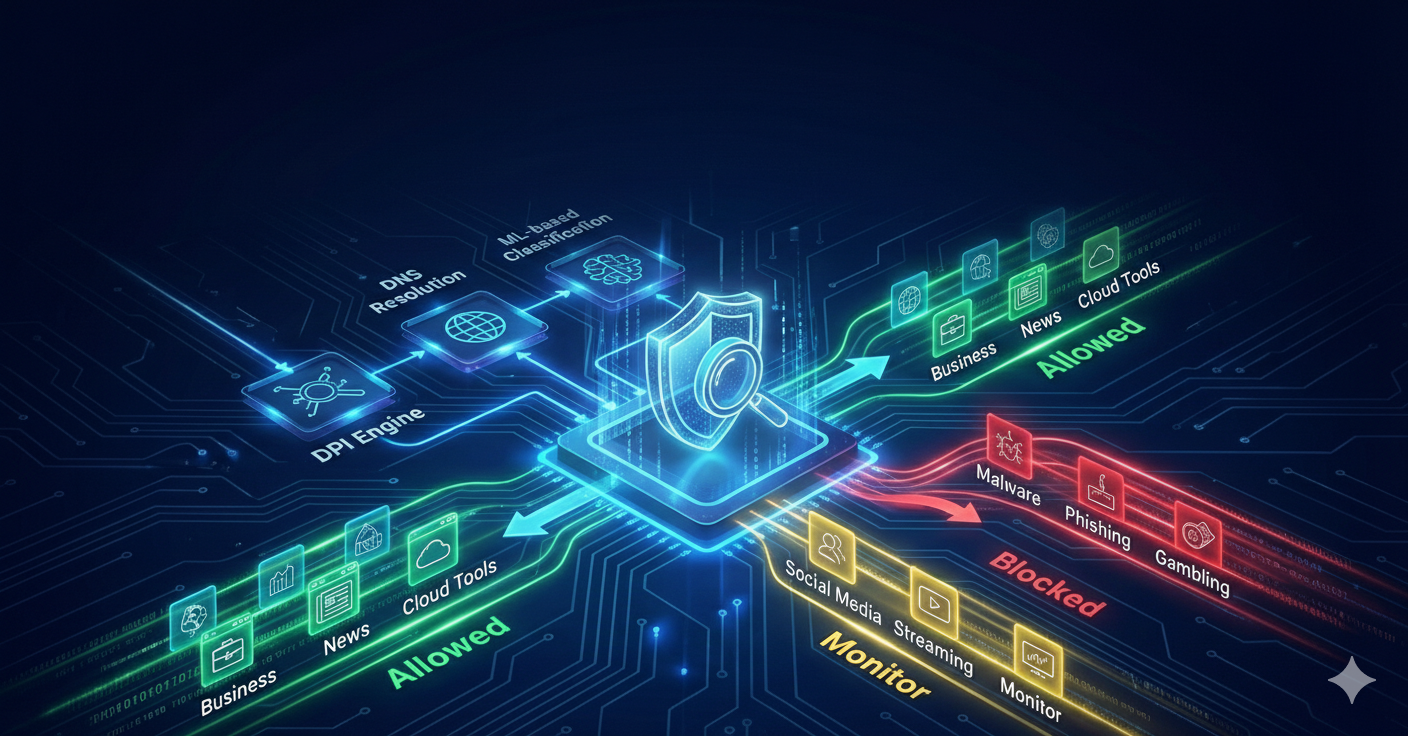
As web traffic continues to grow in volume and complexity, security products such as Secure Web Gateways (SWG), SASE platforms, and CASBs rely heavily on URL filtering to enforce policies and detect threats.
What appears to be a basic feature – blocking or allowing access based on URLs- is technically complex in practice.
This guide explains why URL filtering and categorization are challenging, the core components of an effective engine,
and how security products can go beyond static blocklists to deliver dynamic, real-time protection.
What Is URL Filtering?
URL filtering is the process of:
- Inspecting URLs in outbound web requests
- Classifying or categorizing domains and paths
- Applying policy decisions such as allow, block, monitor, or redirect
It is widely used across:
- SASE and Secure Web Gateway products
- Parental control software
- Corporate firewalls
- Zero Trust enforcement tools
Why Categorization Matters
Raw URLs are not meaningful without context. A domain or path alone does not indicate whether the destination is safe, risky, or malicious.
- Is example.com/news a legitimate media site or a disinformation source?
- Is mydocs.dropbox.com collaboration traffic or data exfiltration?
Accurate categorization allows security teams to:
- Apply business and compliance policies
- Reduce analyst workload by adding context
- Feed higher-quality signals into CASB and DLP systems
What Makes URL Filtering Hard?
URL Obfuscation
- Attackers use redirects, encoding, and URL shorteners
- Engines must resolve final destinations and canonicalize URLs
Dynamic Content
- URLs may vary by user or session
- Requires metadata analysis or content inspection
Rapidly Changing Domains
- Malicious domains appear and disappear quickly
- Requires continuously updated reputation or classification engines
Encrypted Traffic (TLS)
- TLS 1.3 and encrypted SNI reduce visibility
- DPI metadata such as SNI and TLS fingerprints can help
CDNs and Shared Hosting
- Multiple unrelated domains may share the same IP
- Categorization must be domain- and path-aware
Components of a Robust URL Filtering Engine
- DNS Resolution: Match domains against known categories and threat intelligence
- Heuristics and ML-based Classification: Classify uncategorized or newly observed domains
- Caching and TTL-aware Updates: Maintain local caches with periodic synchronization
- DPI and TLS Metadata Integration: Extract domains from encrypted traffic flows
- Policy Mapping Layer: Translate categories into organization-specific access rules
- Multi-language and Path-aware Parsing: Handle global traffic and diverse content types
Use Cases for Security Products
- Secure Web Gateways (SWG): Enforce acceptable use policies and reduce attack surface
- SASE Platforms: Enable cloud-native policy control over web traffic
- XDR Platforms: Add contextual telemetry for threat investigations
- CASB: Detect risky cloud application usage
- IoT Gateways: Prevent device access to unauthorized domains
Testing URL Filtering Accuracy
Key metrics to evaluate include:
- Coverage: Percentage of domains accurately categorized
- Freshness: Time taken to identify new malicious domains
- False Positives and Negatives: Business impact of incorrect decisions
- Latency: Real-time lookups should not add noticeable delay
Accelerate Development with Our DPI SDK
URL categorization becomes significantly more powerful when combined with network-level metadata.
Our DPI SDK enables:
- TLS fingerprinting and SNI extraction
- Protocol parsing for HTTP, HTTPS, DNS, and QUIC
- Integration with external URL classification engines or custom logic
- Ultra-low latency processing for inline inspection
Explore our DPI SDK or book a consultation with our engineering team to integrate this into your product.
Final Thoughts
URL filtering may seem like a basic capability, but it is a critical differentiator in modern security stacks.
Whether you are building for Zero Trust access, secure browsing, or insider threat detection, a reliable and scalable URL categorization pipeline is essential.
Get a demo of our DPI SDK or book a free 30-minute consultation to explore integration paths.